Saratoga Race Course
Racing 101
What the place is, how a race works, who looks after the horses, and how the betting works.
about twelve minutes · read it in the car
Chapter I
The place
What Saratoga is, how long it has been here, and what a day on the grounds actually looks like.
Why people come
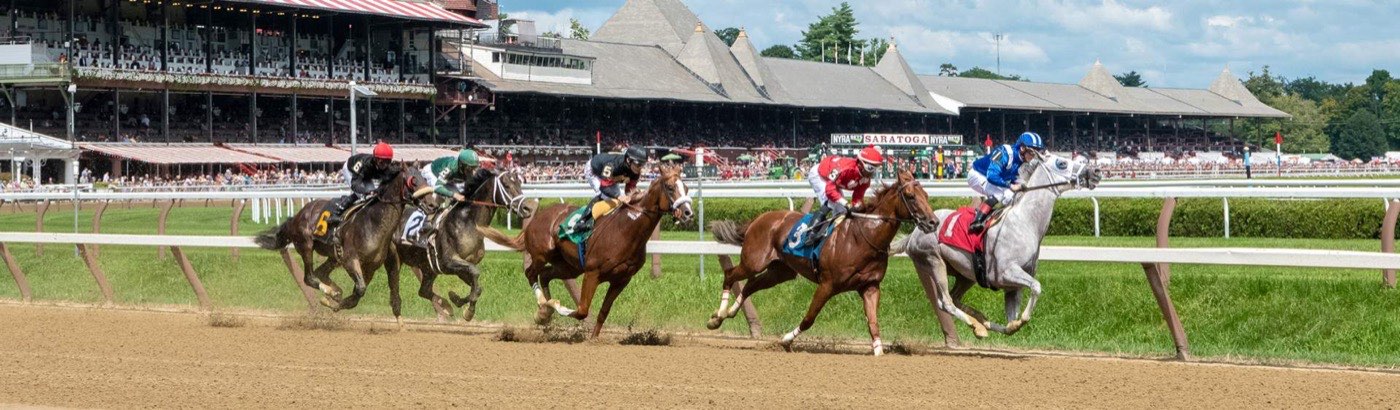
You do not have to bet to have a good day at Saratoga. Plenty of people barely look at the odds.
The backyard is full of picnic tables under old trees. Kids run between them, the paddock fills before each race, and a bugler calls the horses to the track. It feels more like a summer fair than a casino.
Racing started here in August 1863, in the middle of the Civil War. The Travers began the following summer, eleven years before the first Kentucky Derby. The 2026 meet has 46 racing days, but the whole season still fits between July and Labor Day.
Why Saratoga?
Saratoga Springs was already a summer resort because of its mineral springs. Visitors came up from New York City for the season, and racing followed the money.
A day out
Most of the day is spent moving around. You drift between the backyard, the paddock, the food stands, and the rail as each race gets closer.
Breakfast at the track
Horses train early in the morning, and the public can watch from the clubhouse rail. Breakfast is served on the porch while they work. It is the quietest time to see the track.
The backyard
Behind the grandstand, picnic tables sit under old trees. Families and groups claim a table, spread out food, and walk to the rail when a race is close.
The paddock
Before each race, the horses are saddled and walked around a ring a few feet from the crowd. This is your best chance to see them up close before they run.
Downtown afterward
Broadway is a few minutes from the track. Its restaurants and bars stay busy long after the horses are done.
You do not have to choose one spot and stay there. Watch one race from the rail, the next from the grandstand, then skip one altogether and get something to eat.
Race day
Saratoga runs about ten races a day, roughly half an hour apart. Each race has a post time, when the gates are supposed to open. Between races the horses parade in the paddock, the odds move on the board, and you have time to decide on a bet and get to a window.
The rhythm of the day: pick a race, read the field, argue with your friends, bet a few dollars, scream for two minutes, repeat.
Travers Day is longer than usual. This year there are fourteen races, beginning at 11:05 in the morning and ending just after seven. You do not need to follow every one.
The only deadline
Betting closes when the race starts. If the horses are loading, watch this one and bet the next.
Dirt, turf and rain
Saratoga has one dirt track and two turf courses. The surface matters because horses do not all handle them the same way.
The program lists a surface and condition for each race. Dirt is rated fast, good, muddy, or sloppy. Turf is firm, good, yielding, or soft. The wetter the track, the farther you move down each list. Tap or hover a term for a plain-English explanation.
Some horses need dry footing. Others run their best races in mud or on soft grass. Heavy rain can also move a turf race onto the dirt, which may cause trainers to scratch horses entered for grass.
Chapter II
The horse and the people
Why jockeys are the size they are, and what their crouched position does for the horse.
The jockey
Jockeys are small because the job rewards that build. It also demands balance, timing, strength, and nerve.
| Group | Flat jockeys | U.S. adults |
|---|---|---|
| Men | 5'6" | 5'9" |
| Women | 5'2" | 5'4" |
In 1897, American jockey Tod Sloan arrived in England riding with short stirrups and his body folded forward. British racegoers mocked the monkey crouch, but other riders soon copied it. Researchers later linked the position to race times improving by 5 to 7 percent.
Why jockeys are small
Being small helps a jockey stay balanced in a crouch while the horse moves underneath. It does not mean the horse carries less: if the jockey is too light, lead pads are added to the saddle.
At full speed, jockeys balance above the stirrups while steering a thousand-pound horse through traffic. They also have to judge the pace and decide exactly when to ask the horse for more.
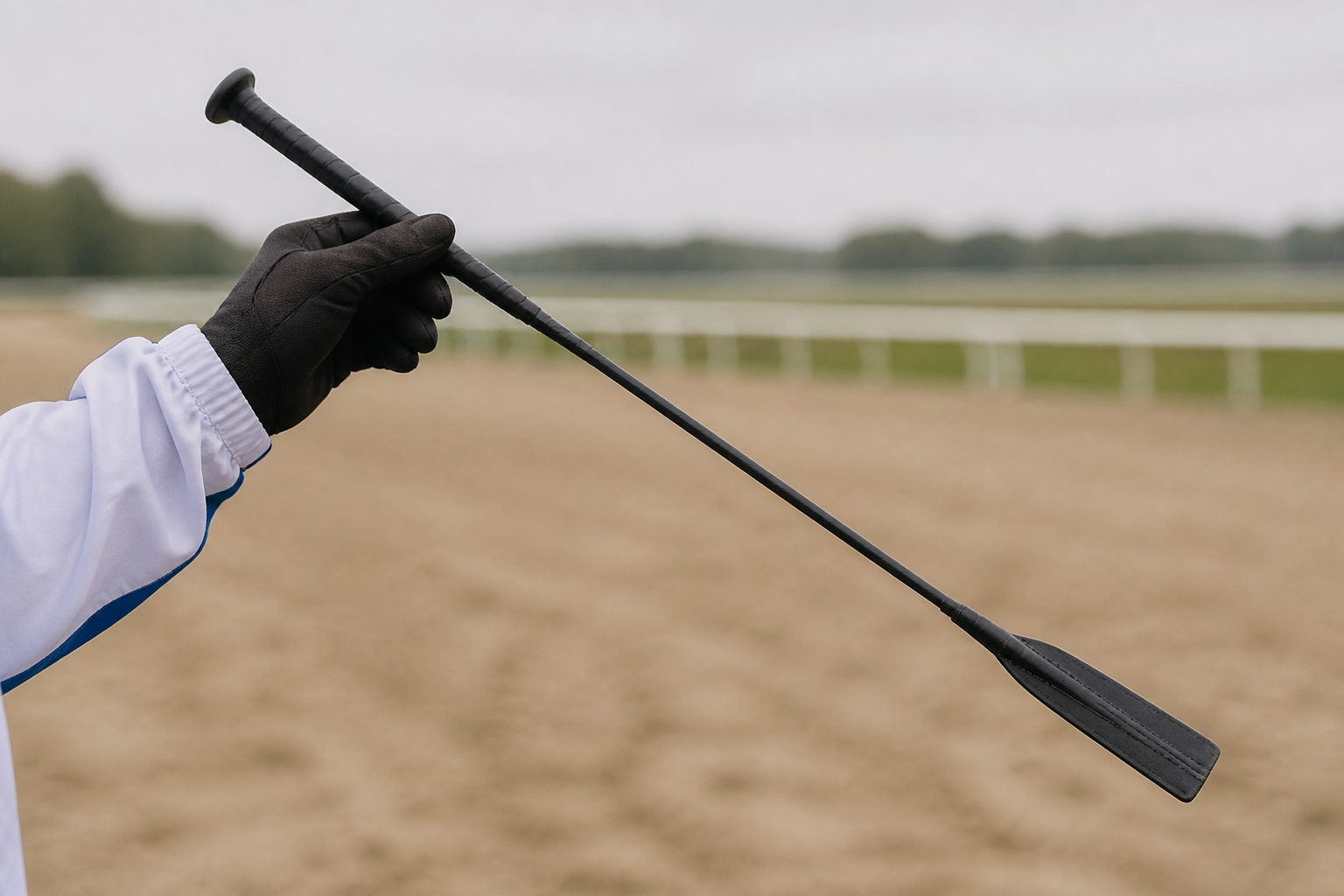
That short, padded stick is called a riding crop. Jockeys use it to focus the horse, ask for a final effort, or avoid danger. A rider may use it six times in a race, no more than twice in a row, then must allow at least two strides for the horse to respond. Going over can mean a fine or suspension.
Chapter III
The history
Saratoga has been running horses since the Civil War, and the Travers has been its biggest race for almost all of that time.
Famous upsets
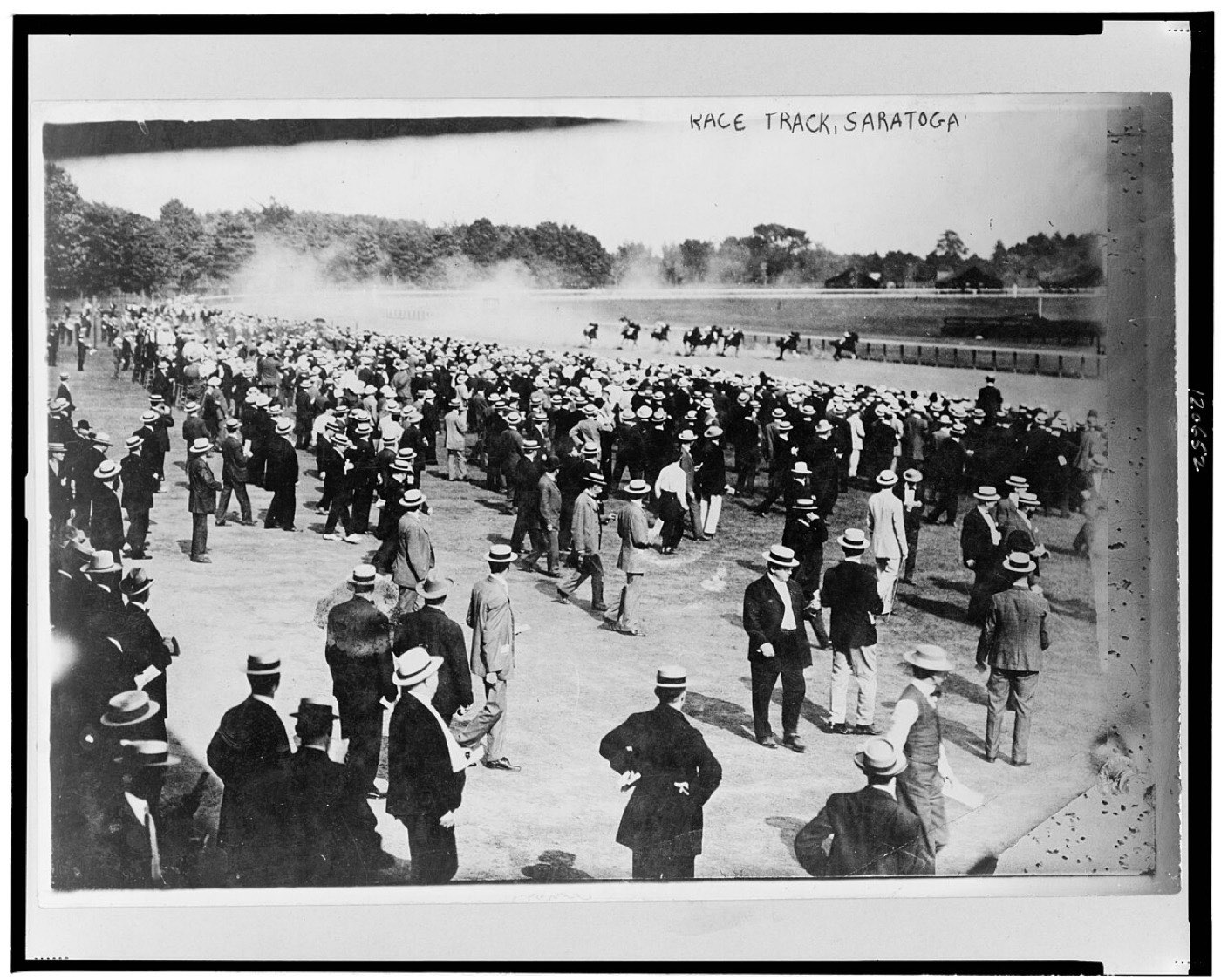
They call it the Graveyard of Champions, and the record backs it up. Saratoga has a long, well-documented habit of humiliating great horses.
1863
The track opens
Saratoga’s first meet runs a month after Gettysburg, which makes it one of the oldest sporting venues in America.
1864
The first Travers Stakes
Older than the Kentucky Derby, and still the race the whole town plans its August around.
1919
Man o’ War meets Upset
Man o’ War lost exactly one race in his career. It happened here, to a horse literally named Upset.
1930
Jim Dandy at 100-1
Gallant Fox had already won the Triple Crown that year. He lost the Travers to a 100-1 shot named Jim Dandy.
1973
Secretariat meets Onion
Months after the Triple Crown, the greatest horse anyone had ever seen was beaten here by a horse named Onion. Three champions, three upsets. That is how Saratoga got its nickname.
Today
Travers Day
The Travers is still the biggest Saturday of the meet. Favorites are never safe at the Spa, which is exactly why the betting is fun.
Travers Day
The Travers Stakes is the reason this Saturday is the biggest day of the Saratoga meet. It is the oldest stakes race in America for three-year-olds only, and the meet is built around it.
- First run
- 1864, eleven years before the Kentucky Derby
- Distance
- A mile and a quarter, the same as the Derby
- Named for
- William R. Travers, the track’s first president
- Also known as
- The Midsummer Derby
A three-year-old is a young horse near the start of its career. Most run for the first time at two, so this is their second season. Racing groups horses by age, and the great classic races admit nobody else, so a horse gets one shot at them in its life and never another. The bookkeeping is tidier than you would guess: every Thoroughbred officially turns a year older on January 1 whatever month it was actually born, so the whole crop moves up together.
The Triple Crown races are three-year-old races too, so the Travers field is drawn from the same crop that contested them in the spring: the Kentucky Derby in May, the Preakness two weeks later, the Belmont in June. By late August those horses have had a summer to grow up, and the Travers is often the first time they meet again. That is where the nickname comes from: the Midsummer Derby, run over the Derby’s own mile and a quarter.
It also has the best trophy in racing that isn’t a trophy. A canoe floats in the pond in the infield, and it is painted in the racing colors of the most recent winner’s owner, so the infield quietly advertises who won last year until somebody takes it away from them.
Cross-reference
One of the upsets in the timeline above happened in this very race: Gallant Fox, that year’s Triple Crown winner, losing the 1930 Travers to 100-1 Jim Dandy. Saratoga now runs a Jim Dandy Stakes earlier in the meet as a Travers prep, named after the horse nobody backed.
Expect the biggest crowd of the meet. The backyard fills early, the town is full, and the whole day builds toward one race in the early evening.
Chapter IV
Betting
How to read a price, what the bets are, and how to say one out loud at the window.
Reading the program
The program is the day’s cast list. Every horse gets a number, a jockey, a trainer, and a line of recent results.
The form line is the string of finishing positions in a horse’s recent races, most recent last. “211” means it ran 2nd, then won twice. That one string is most of what people are arguing about at the rail.
The number also sets the saddle-cloth color the horse wears. These are the same colors this app uses everywhere, so the chip on your screen matches the cloth on the track:
Worth knowing
You bet the number, never the name. Nobody at a window wants to hear “the grey one with the nice face.”
Reading the odds
Odds are a price tag, not a prediction. They tell you what a winning ticket pays, and by extension what the crowd thinks.
5-2 odds mean a winning $2 bet returns $7, which is $5 of profit plus your $2 back. Flip that around and 5-2 implies roughly a 29% chance of winning.
| Odds | A $2 win bet returns | Roughly what the crowd thinks |
|---|---|---|
| 1-1 (even money) | $4 | about 50% |
| 5-2 | $7 | about 29% |
| 9-1 | $20 | about 10% |
| 20-1 | $42 | about 5% |
The morning line is the track’s opening estimate of where the odds will land. The board then moves with real money right up to post time. When your read on a horse is better than the crowd’s price, that gap is what people mean by value.
Read this twice
The number on the board is not a promise. Odds keep moving until the gates open, and you are paid the final price, not the one you saw when you handed over your money.
The bet calculator has a cheat sheet of every common price.
Win, place and show
Three bets cover one horse in one race, and they are the easiest tickets to read and to cash.
- Win
- Your horse finishes 1st.
- Place
- 1st or 2nd. Smaller payout, two ways to be right.
- Show
- Top three. Smaller still, three ways to be right.
Minimums are usually $1 or $2. The program lists the menu for each race. Across the board is one ticket carrying all three, so a $2 across the board costs $6. If your horse wins, all three parts pay; if it runs 3rd, only the show part does.
At the window
Say it in this order: race number, dollars, bet type, horse number. “Race five, ten dollars to win on the four.” Check the ticket before you walk away. A bad ticket can’t be fixed once the race is off.
Exotic bets
Exotics ask for more than one horse. They pay more because they are harder, and they get expensive faster than people expect.
In a single race: an exacta is the top two in exact order, a quinella is the top two in either order, a trifecta is the top three in order, and a superfecta is the top four.
There are two ways to spread out. A box covers every order of the horses you picked. A key puts one horse on top with the others underneath. Cheaper, but your key has to win.
Every combination is its own bet
A $1 exacta box of three horses covers six orders, so it costs $6. Add a fourth horse and it is twelve orders, $12.
A $1 Pick 3 with two horses in each of the three legs is 2 × 2 × 2 = eight combinations, $8.
Multi-race bets chain winners together: the Daily Double is two races, then Pick 3, 4, 5 and 6 go on from there. Because the legs multiply, price one in the calculator before you get to the window.
The parimutuel pool
There is no bookmaker here. Racing is parimutuel, which means you are betting against the crowd rather than against the house.
All the win bets go into one pool, all the exacta bets into another, and so on. The track takes its cut, and whoever holds winning tickets splits what is left. That is why odds move until post time. They are just a live picture of where everyone’s money is sitting.
It is also why a smart, unpopular opinion pays better than a smart, popular one. Backing the horse everybody already likes means sharing the pool with everybody.
The win-chance bars on the races page are worth a look next to the board price.
Chapter V
The tools
What the rest of this app is for once you’re standing at the rail.
Now use the toys
You now know more than most people in the grandstand. The rest of this app is for the arguing.
Races
Today’s card with the field, the form and the odds bars.
Past performances
Tap any horse for every start it has run — the record the crowd is pricing, so you can argue with the board over track fries.
Bet calculator
What a ticket costs and what a price pays, before you are standing at the window.
The guide will answer anything, and no question is too basic. That is the entire point of it.